Course Overview. The Colt course, named after renowned architect Harry Colt, was opened in 2011 and designed by Scott Macpherson; with Lee Westwood’s later input – which involved the addition of new tees and bunkering – we have the course, as it’s presented this week, measuring 6,872 yards for its par of 71. The routing and par has changed since the 2017 renewal according to the European Tour’s website, however we’re still on the same expanse of land so let’s assume that those changes are for the better, avoiding as we had before a finishing hole as a par 3, for instance.
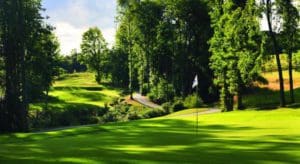
Parkland in nature with a few tree-lined and some more exposed holes, the course features average to generous width fairways flanked by long, wispy grass and well-placed bunkers to keep players honest from off the tee. Dog-legs and significant elevation changes, as well as the requirement to be finding the right portion of fairways to attack the tricky, undulating putting surfaces, make this more a test of strategy than brute force. Greens are Creeping Bentgrass and although they’re USGA standard, aren’t massively quick due to the contours on the greens.
In his interview after lifting the trophy in 2017, Paul Dunne had this to say about the course, “The course was hilly, lots of elevation change. It was in great condition. The fairways were wide, which kind of fit into my game a little bit because when I struggled this year, it’s been with accuracy off the tee. So there was more emphasis on iron play and short game, which suits me.”

Tournament Stats. We’ve published some key statistics for this week’s event that will help to shape a view on players who traditionally play well at this event. As ever, it’s worth noting that only the 2017 tournament was held here at Close House: Current Form | Event Form | First Round Leader Stats | Combined Stats.
Predictor Model. Our published Predictor Model is available here. As always you can build your own model using the variables available.
Winners & Prices. 2019: Marcus Kinhult, 175/1; 2018: Eddie Pepperell, 30/1; 2017: Paul Dunne, 66/1; 2016: Alex Noren, 18/1; 2015: Matt Fitzpatrick, 33/1.
For a summary of winners’ odds on the European Tour for the past 10 years click here.
Weather Forecast. The latest weather forecast for the area is here. Summer in Newcastle-Upon-Tyne means temperatures approaching 70 Fahrenheit in the afternoon and sunshine with the odd shower, although at the time of writing there’s a chance of a little more significant rain as the weekend approaches. Winds will be westerly and moderate at times at around 10-15mph, which will keep the players honest without causing them a massive headache.
Tournament Trends & Key Factors.
Analysing the final stats of the top 6 finishers here at Close House in 2017 gives us some indication as to what style of game this track demands:
- 1st, Paul Dunne (-20). 53.6% fairways (42nd), 70.8% greens in regulation (32nd), 85.7% scrambling (1st), 1.63 putts per GIR (4th).
- 2nd, Rory McIlroy (-17). 50% fairways (51st), 77.8% greens in regulation (8th), 75% scrambling (5th), 1.82 putts per GIR (57th).
- 3rd, Robert Karlsson (-16). 58.9% fairways (33rd), 76.4% greens in regulation (11th), 70.6% scrambling (11th), 1.75 putts per GIR (26th).
- 4th, Florian Fritsch (-14). 48.2% fairways (56th), 75.0% greens in regulation (17th), 66.7% scrambling (18th), 1.67 putts per GIR (9th).
- 4th, David Lingmerth (-14). 64.3% fairways (11th), 68.1% greens in regulation (46th), 65.2% scrambling (24th), 1.59 putts per GIR (1st).
- 4th, Graeme Storm (-14). 69.2% fairways (2nd), 79.2% greens in regulation (6th), 60.0% scrambling (35th), 1.68 putts per GIR (13th).
Let’s take Rory McIlroy out of the equation for one moment as his stats might skew the overall picture. Naturally, had he won the event – which save for the final round heroics from Paul Dunne was quite likely – then you could argue that a strong tee-to-green game is required here. The counter-argument of course is that an elite player like Rory can contend with his shape of game on virtually any track at European Tour level, so analysing how the former world number 1 plays is not a strong angle to pursue in my view.
With the exception of Graeme Storm, accuracy from the tee wasn’t that critical and in general there wasn’t a massive amount of variance in GIR performance throughout the field who made the weekend. That puts the emphasis very much on performance on and around the greens with scrambling and putting ultimately dictating who finished higher up the leaderboard.
- 1st, Paul Dunne (-20). Par 3: Even; Par 4: -12; Par 5: -8; Eagles: 1; Birdies: 21; Bogeys: 3.
- 2nd, Rory McIlroy (-17). Par 3: -1; Par 4: -9; Par 5: -7; Eagles: 0; Birdies: 21; Bogeys: 4.
- 3rd, Robert Karlsson (-16). Par 3: -3; Par 4: -8; Par 5: -5; Eagles: 1; Birdies: 19; Bogeys: 5.
- 4th, Florian Fritsch (-14). Par 3: Even; Par 4: -10; Par 5: -4; Eagles: 1; Birdies: 18; Bogeys: 6.
- 4th, David Lingmerth (-14). Par 3: -5; Par 4: -6; Par 5: -3; Eagles: 0; Birdies: 22; Bogeys: 8.
- 4th, Graeme Storm (-14). Par 3: +1; Par 4: -12; Par 5: -3; Eagles: 0; Birdies: 20; Bogeys: 6.
Back in 2017, eventual winner Paul Dunne was 8-under for the 8 looks he had on the par-5s for the week; runner-up Rory McIlroy was 7-under on the same count. On a scoreable par-70 though, the critical difference between success and failure was how a player scored on the par-4s with Dunne co-leading on that count at 12-under. The Irishman also led the field for bogey avoidance, dropping just 3 shots all week, which reinforces my previous point about scrambling.
Incoming Form: Since the British Masters was re-established in 2015, the four winners prior to Marcus Kinhult – Eddie Pepperell, Paul Dunne, Alex Noren and Matt Fitzpatrick – had each shown some decent enough form in the weeks prior to their victory. Last year’s winner Kinhult was far more difficult to find as he’d missed each of his previous 4 cuts, shooting 80 on his previous competitive round before opening with a 65 at Hillside and hardly looking back.
Eddie Pepperell had recorded 5 top-10 finishes in his previous 8 starts, 2 of which were runner-up finishes at the Scottish Open and Portugal Masters. Paul Dunne had produced two top-15 finishes in his previous three strokeplay events and after a shaky 74 to start on his most recent start in Holland, nobody in the field bettered his final 3-round total. For Noren this was the third of four 2016 victories and he was clearly in exceptional form overall whereas for Fitzpatrick his win at Woburn marked his maiden success on the European Tour, however with four top-3 finishes in his previous 11 events he was clearly knocking very loudly on the door:
- 2019, Marcus Kinhult: 22/30/71/22/20/MC/MC/18/MC/MC/MC/MC
- 2018, Eddie Pepperell: 43/51/DQ/MC/2/6/59/9/56/6/2/44
- 2017, Paul Dunne: 33/30/MC/MC/13/54/26/MC/9/14/70/14
- 2016, Alex Noren: MC/43/12/MC/8/1/46/49/2/1/34/11
- 2015, Matt Fitzpatrick: MC/3/MC/MC/77/2/17/44/3/30/3/MC
Although we only have 2017 to go on in terms of tangible European Tour form, that renewal does give us a few clues as to what type of player may contend here this week. The fairways are generally quite wide here, albeit the penalty for seriously wide shots may be more severe here this year given that the 70,000 members of the public won’t be here to trample down the rough this time around over the 4 days.
For me this is a second shot course, where slick short iron and wedge play is key, as is performance on and around the greens. Bentgrass-positive players will enjoy these greens, however there are a lot of slopes and undulations on the putting surfaces which will tend to favour those who are more competent with the flat stick. Top-class scrambling, 3-putt avoidance and putting in general are good assets to have here in my view.